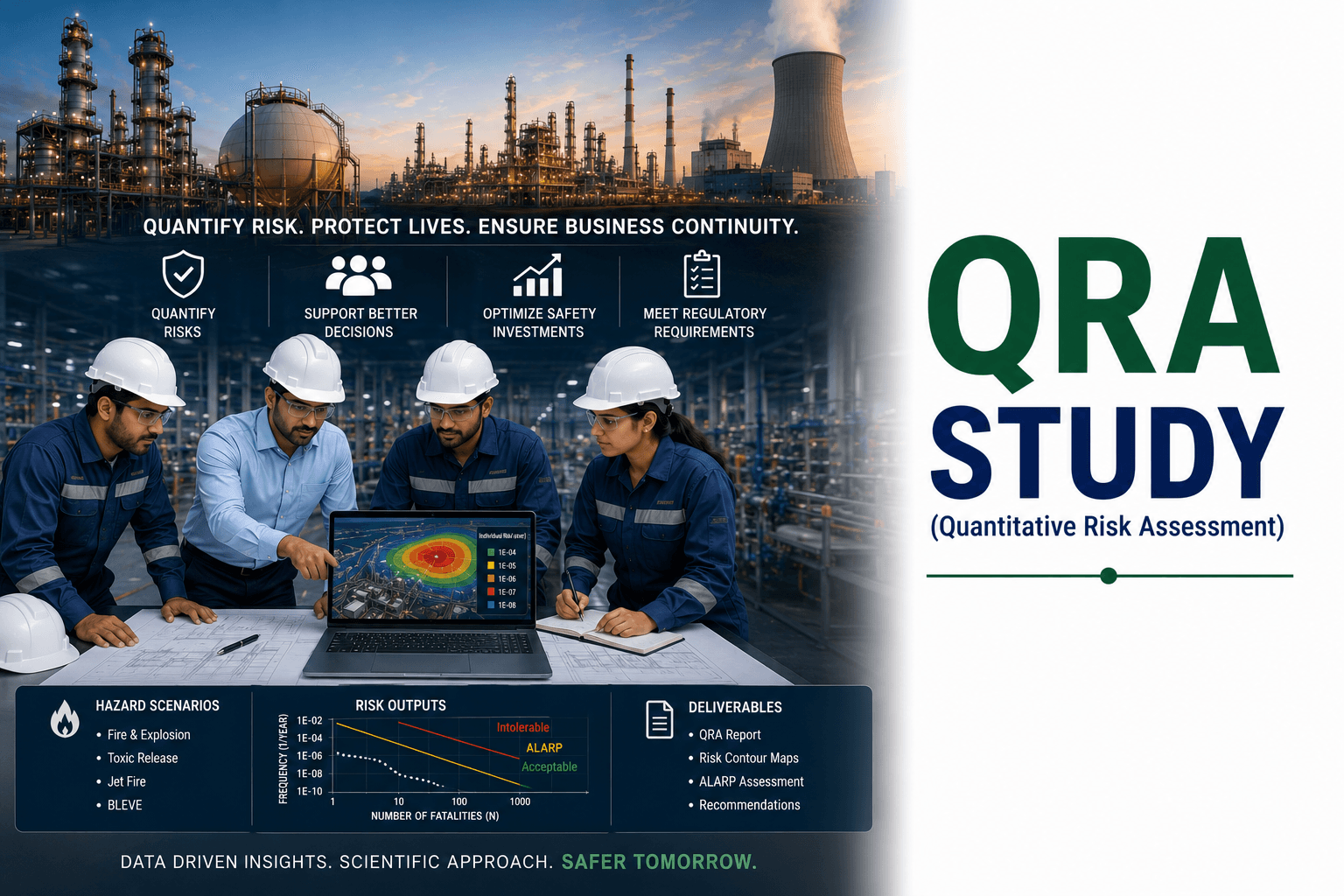
QRA Study (Quantitative Risk Assessment)
Software-based QRA studies to quantify hazardous event likelihood, consequence impact, and risk levels for critical decision-making.
Overview
Our QRA (Quantitative Risk Assessment) Study is a software-based, data-driven approach to quantifying the risks associated with major hazards in industrial facilities. QRA goes beyond qualitative risk assessment by using mathematical models to calculate the likelihood and consequences of hazardous events, providing a numerical basis for critical safety and design decisions.
The QRA process includes hazard identification, frequency analysis using historical failure data and fault tree analysis, consequence modeling using specialized software for dispersion, fire, explosion, and toxic release scenarios, and risk integration to produce individual and societal risk contours. We also perform ALARP (As Low As Reasonably Practicable) analysis to determine whether risks are acceptable or further reduction is required.
The QRA report provides detailed risk contours overlaid on site maps, F-N curves for societal risk, individual risk per location, and a clear set of recommendations for risk reduction. This report is essential for facilities handling large quantities of hazardous chemicals, supporting land-use planning decisions, emergency response planning, and regulatory compliance.
Key Features
- Software-based consequence modeling for dispersion, fire, explosion, and toxic release
- Frequency analysis using historical data and fault tree analysis
- Individual and societal risk contour generation
- ALARP (As Low As Reasonably Practicable) analysis
- F-N curves for societal risk evaluation
- Comprehensive report with risk maps and reduction recommendations
Benefits
- Provides a quantitative basis for critical safety and design decisions
- Supports land-use planning and emergency response planning
- Satisfies regulatory requirements for major hazard facilities
- Demonstrates that risks are ALARP for regulatory and insurance purposes
- Enables prioritization of risk reduction investments based on quantified benefits
Need this service for your facility?
Get in touch with our team of certified professionals to discuss your requirements and schedule a consultation.
Book This Service